
Open any pantry or warehouse inventory, and you will likely find sustainable palm oil products on every shelf. This ingredient is the hidden champion behind the smooth texture of cosmetics and the stability of baked goods. Manufacturers rely on it because it is odorless, colorless, and offers a natural preservative quality that few other ingredients can match.
However, this popularity has historically come with a heavy cost. For decades, rapid expansion drove deforestation in tropical regions, sparking global outrage. Consumers and procurement officers alike began asking a tough question: “Is it time to stop using this ingredient altogether?”
Today, a new wave of innovation promises a fix – biotech palm oil alternatives. These companies use microbes and fermentation, similar to brewing beer, to create oil in a factory. It sounds like the perfect answer: all the oil, none of the trees. Brands looking for a quick sustainability win are often tempted to switch to these “synthetic” options to avoid supply chain risks.
The Reality: Scale, Soil, and Society
But the reality of feeding the world is more complex than a lab experiment. While biotech offers possibilities for niche markets, it cannot yet match the economic scale or efficiency of agriculture.
Key Statistic:
Oil palm is the world’s most efficient oil crop, producing 3.3 tonnes per hectare compared to just 0.4 tonnes for soy. Replacing it often means using more land, not less.
The most effective solution isn’t abandoning the crop. Instead, we must ensure sustainable palm oil products are sourced from regenerative, deforestation-free farms that heal the land rather than harm it. As we explore in our guide on the future of palm, the answer is optimization, not replacement.
The Efficiency Paradox: Why “Palm-Free” Isn’t Always Sustainable
When shoppers see a “palm-free” label, they often assume it is the best choice for the planet. However, the math tells a different story. To replace the world’s demand for sustainable palm oil products with alternatives, we would need to clear millions of additional hectares of land.
This creates what experts call the “boycott paradox.” Replacing palm oil doesn’t solve deforestation; it simply shifts the destruction to less efficient crops.
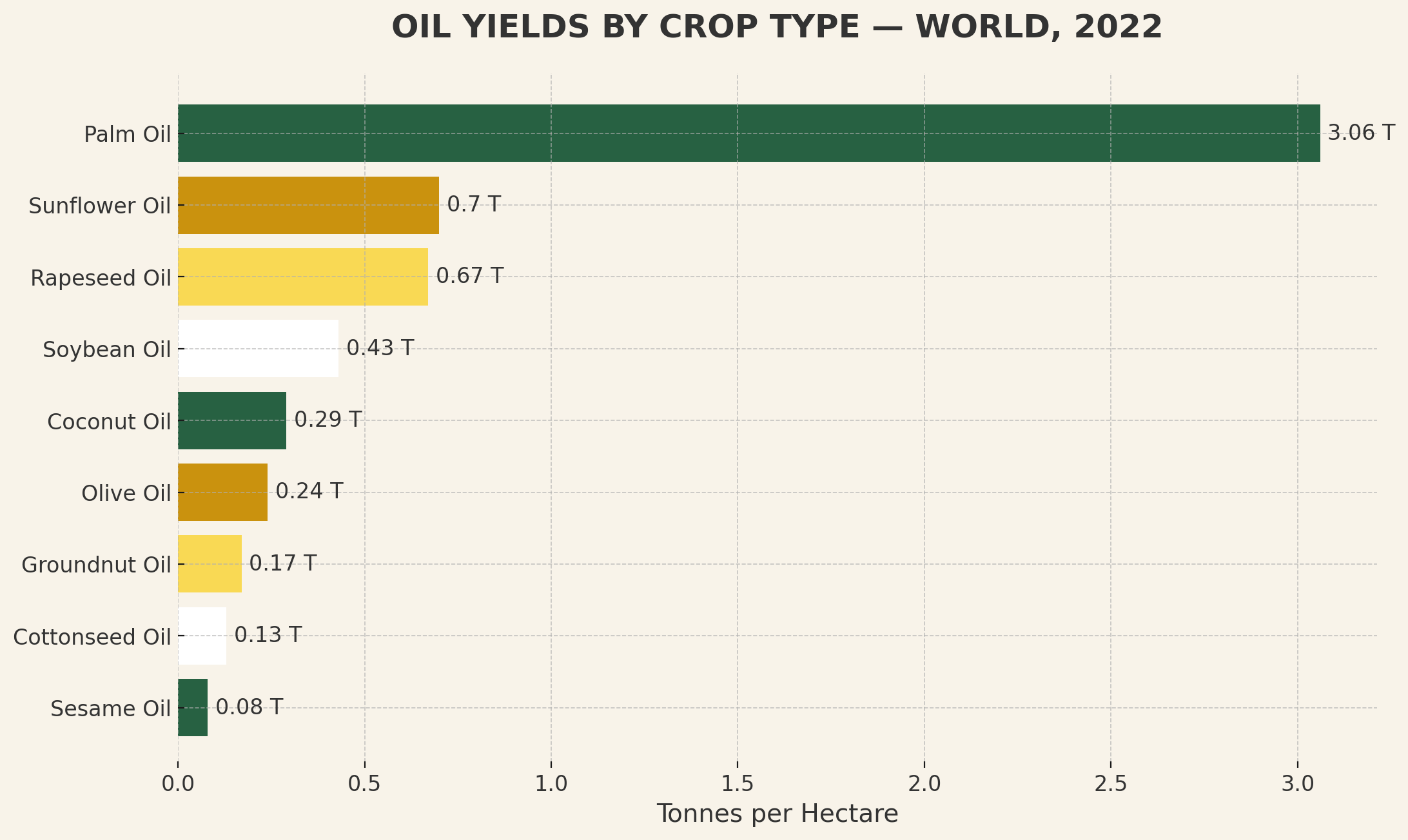
Source: Food and Agriculture Association of the United Nations, 2025
Data: The Unmatched Efficiency of Palm
According to WWF data, the oil palm is the most efficient oil crop on Earth. To produce the same amount of oil as one hectare of palm, you would need significantly more land for alternatives:
- Palm Oil: 1 hectare (Baseline)
- Sunflower: 4+ hectares required
- Soybean: 7+ hectares required
But efficiency isn’t just about land. It’s also about inputs. Research shows that palm oil requires drastically less nitrogen fertilizer—~30 kg per tonne of oil compared to ~100 kg for rapeseed. For brands tracking carbon footprints, this makes sustainable palm oil a superior choice for reducing Scope 3 emissions.
Performance: Why Kitchens Rely on It
Beyond sustainability metrics, palm oil offers functional benefits that “lab-grown” or liquid alternatives struggle to replicate without chemical processing.
- Texture & Structure: It is naturally semi-solid at room temperature, providing the creamy texture in spreads and doughs without the need for hydrogenation. This makes it a key ingredient in the Seed Oil Free movement.
- Stability: Specific fractions like AMPO are prized for their high smoke point. They remain stable at high temperatures, resisting oxidation and rancidity far better than soy or sunflower oils.
Pro Tip for Procurement: Switching to a “palm-free” formula often requires introducing hydrogenated fats or complex emulsifiers to mimic palm’s natural properties. Stick to Certified Organic Palm Oil to maintain clean-label status.
The Biotech Promise vs. The Supply Chain Reality
In the search for palm oil alternatives, the most headline-grabbing innovation is “precision fermentation.” Companies like C16 Biosciences are using specialized microbes and yeast to ferment sugar into oil, a process that closely resembles brewing beer.
The environmental claims are impressive: proponents state these methods can generate oil while using up to 99% less land and producing significantly fewer emissions. However, for a global food brand, the math simply doesn’t add up yet.
The “Green Premium” Hurdle
This high-tech solution faces a massive economic hurdle known as the “green premium”.
- Cosmetics (High Margin):
Lab-grown palm oilis finding a home in skincare, where profit margins are often 50%+. Brands can absorb the high cost of synthetic ingredients to claim “palm-free” status. - Food (Low Margin): Food manufacturers operate on razor-thin margins. They cannot afford expensive alternatives without skyrocketing prices for everyday groceries.
The Scale Gap: Lab vs. Land
Scale is the final, undeniable challenge. The global palm oil industry produces over 72 million tons of oil annually to feed the world. While startups are making progress, analysts warn it could take decades for them to reach a production scale that competes with conventionally grown palm.
| Feature | Lab-Grown Alternatives | Sustainable Palm Oil (DAABON) |
|---|---|---|
| 💰 Cost |
High (Luxury/Niche) Not viable for mass food supply |
Competitive (Mass Market) Economical for global scale |
| 📦 Scale |
Low Volume Years away from matching global demand |
High Volume (Scalable) Already serving global markets |
| ⚡ Energy |
High (Bioreactors) Energy-intensive fermentation systems |
Low (Solar / Photosynthesis) Naturally carbon-efficient |
| 🚚 Availability |
Limited Experimental rollout phase |
Ready for Export Commercially available today |
Until biotech can solve these issues, relying on lab-grown solutions is a supply chain gamble. The immediate answer lies in innovation within the field, not just the factory.
The “Mend It” Solution: DAABON’s Regenerative Approach
We do not need to wait 50 years for a scalable solution; it already exists today. Rather than betting on a future tech breakthrough, the most practical path forward is a “mend it, don’t end it” approach. By fixing supply chains and enforcing rigorous standards, agriculture can immediately deliver organic sustainable palm oil that restores the planet.
DAABON USA stands as the prime case study for this model. As the first palm oil producer to become Regenerative Organic Certified® (ROC™ GOLD), DAABON has moved beyond simply “doing less harm” to actively restoring ecosystems.
The 3 Pillars of Regenerative Palm
For procurement officers seeking deforestation-free supply chains, DAABON’s strategy offers three verifiable layers of protection:
- Biodiversity Corridors: Instead of monocultures, DAABON creates connecting sections of forest that allow wildlife to travel freely. This protects vital habitats for species like the endangered turtle and prevents ecological isolation.
- Circular Soil Health: We employ circular economy principles—including no-till farming, crop rotation, and cover crops. This maintains soil health without relying on the chemical inputs that degrade land over time.
- Satellite Verification: Trust is good; verification is better. DAABON uses satellite imagery and remote sensors to monitor forests 24/7, ensuring that absolutely no deforestation occurs within the supply chain.
Key Takeaway: DAABON isn’t just “sustainable”; it is Verified Carbon Neutral. By integrating biodiversity support directly into the plantation model, we prove that high-yield farming can coexist with nature.
The Human Element: Why Communities Need Sustainable Palm
Beyond the environmental debate, there is a critical human reality: the global industry supports millions of smallholder farmers. In countries like Colombia, this crop is not just a commodity; it is a primary livelihood.
For these families, the oil palm offers stability. As WWF notes, boycotting is not the answer because it threatens the livelihoods of millions. Instead, the focus must be on transformation.
Data: Oil Palm Drives Education
When procurement leaders choose sustainable palm oil products, they invest directly in human capital. Research shows that oil palm cultivation leads to significant improvements in living standards:
- Schooling: Farm households increase spending on child education by >30%.
- Higher Ed: Spending on college/university rises by nearly 40%.
By supporting responsible supply chains like DAABON’s, you aren’t just protecting forests—you are sending children to school.
Conclusion: The Choice is Regeneration
The debate is often framed as “Palm Oil vs. The Planet.” But the evidence shows this is a false dichotomy. The real choice is between destructive production or a regenerative model that restores the environment.
While lab-grown innovations remain a niche solution for high-end cosmetics, they cannot yet feed the world. For the global food supply, which demands scale and affordability, regenerative agriculture is the only ethical path forward.
Take Action for Your Supply Chain
The power lies in procurement. By insisting on rigorous certifications like RSPO, Fair Trade, and Regenerative Organic Certified® (ROC™), you ensure your ingredients are part of the solution.
Ready to secure a scalable, ethical supply?
- Explore our Certified Organic Product Portfolio
- Contact DAABON USA to request specs and samples.
The future is not about replacing the oil palm; it is about growing it right.