DAABON is an organic palm fruit shortening supplier to US food manufacturers, shipping in bulk from our own plantations in Colombia and Brazil. Every batch is traceable to the plantation that grew it and is certified USDA Organic, RSPO, Fair Trade USA and Non-GMO. Tell us your application and volume, and we will send a specification sheet and a sample.
What Is Organic Palm Fruit Shortening?
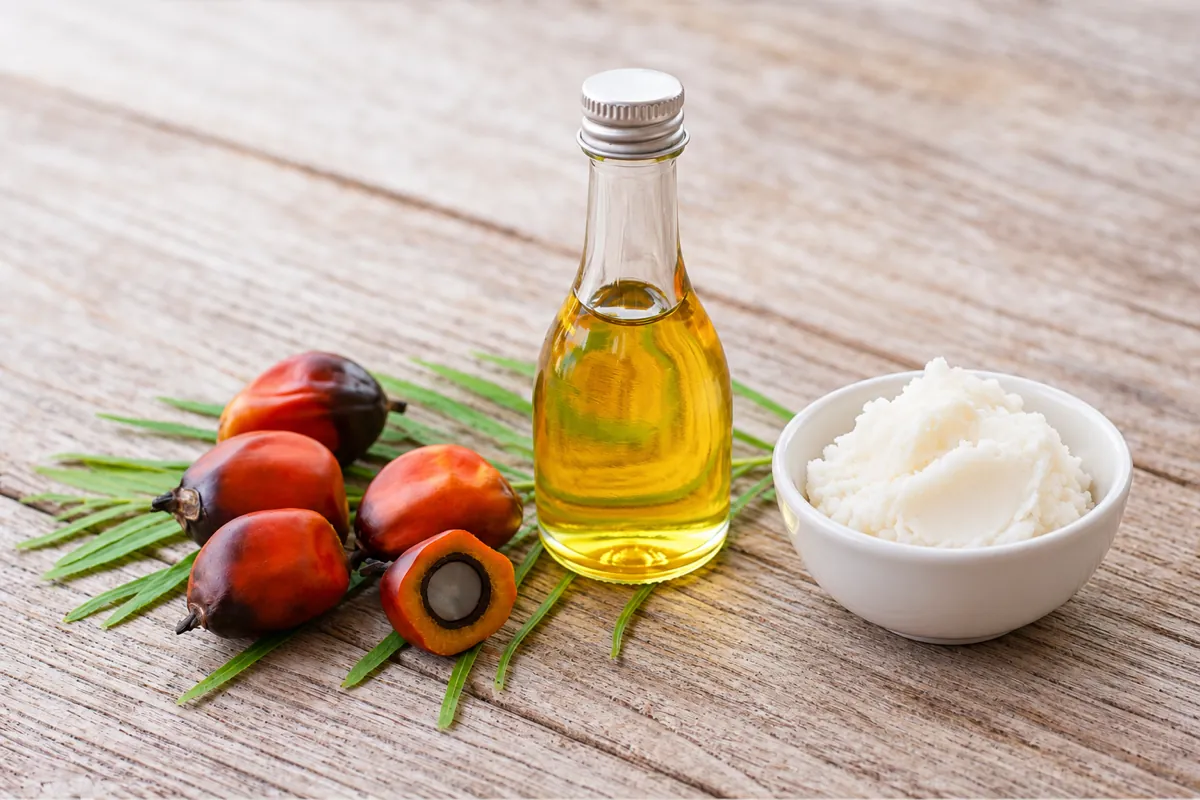
Palm fruit shortening is a semi-solid fat made from the flesh of the palm fruit, not the seed. Crude palm oil is fractionated, which separates it into a liquid olein and a solid stearin, and the stearin fraction is what gives shortening its structure at room temperature.
It reaches that structure without hydrogenation. That matters on a label: non-hydrogenated palm shortening carries no trans-isomerised fats, which is why many manufacturers moved to it from partially hydrogenated vegetable shortening in the first place. The flavour is neutral, so it carries the formulation rather than competing with it.
Organic certification governs what went into the ground long before any of that. The USDA National Organic Program restricts synthetic fertilizers and pesticides across the growing cycle, so an organic shortening claim reaches back to the plantation, not just the refinery.
One question comes up often enough to answer directly. Palm fruit shortening is not a seed oil. It is pressed from the mesocarp, the fleshy part of the fruit, in the same way palm oil is.
Seed oils are pressed from seeds and are high in omega-6 linoleic acid. Palm fruit shortening is low in it and solid at room temperature. We cover that distinction in full in our guide to palm oil and seed oils.
Which Palm Shortening Grade Do You Need?
Shortening is specified by melt point. It is the number that decides whether a cookie holds its shape, a pie crust flakes, or a fried product releases cleanly instead of sitting greasy on the plate. Two shortenings can carry identical certifications and behave nothing alike in your process.
DAABON publishes its shortening range by melting point, in Celsius and in Fahrenheit for a US plant floor. Five grades span the range from a soft creaming fat to hard stock.
| Grade | Melt point | Behaves like | Typical applications |
|---|---|---|---|
| Soft | 32°C / 90°F | Softest, creams readily, melts below body temperature | Soft cookies, soft fillings, bread, cakes, frying, flavour carrier |
| All purpose | 36–38°C / 97–100°F | Semi-solid at room temperature, white, neutral in flavour | Medium-hard cookies, dry cereal, bread, infant formula, dairy substitutes, soap |
| 39 | 39°C / 102°F | Firm, holds structure in a warm plant | Doughnuts, hard cookies, hard fillings, icings, bread and biscuits, frying, soap |
| 42 | 42°C / 108°F | Hard stock, high structural hold | Biscuits, instant soups, nut butters, crackers, nutrition bars, microwave popcorn, soap |
| 45 | 45°C / 113°F | Hardest, stable through hot-climate distribution | Margarine blends, frying, instant soups, nutrition bars, crackers, nut butters, microwave popcorn, soap, cosmetics |
Two things are worth knowing before you specify. Melt point is a single figure describing a curve, so ask for the solid fat content profile, which shows how much fat stays solid at each temperature and predicts behaviour far better than one number.
The second is that the right grade depends on your plant as much as your product. A bakery running warm through summer benefits from a higher melt point regardless of what is being baked.
If none of the five is right for your process, we also supply customised palm blends. Tell us the melt point and the application you are formulating for.
Applications by Industry
Bakery
Shortening does two jobs in a bakery. Creamed with sugar it aerates, holding the air that lifts cakes and gives cookies their crumb. Cut into flour it stays in discrete pieces, and those pieces become the steam pockets that make a pie crust or a laminated dough flake.
It is also the reason commercial bakeries reach for shortening rather than butter. Butter is roughly 80% fat, with the rest water and milk solids, while shortening is 100% fat, so it delivers predictable structure without the water that toughens a dough. A neutral flavour matters more here than anywhere else, because nothing masks an off note in a plain sweet dough.
Snacks and Frying
In a fryer, the question is how long the fat lasts before it breaks down. Palm shortening is naturally high in saturated fat and low in polyunsaturates, which is precisely what resists oxidation at temperature. Longer fry life means fewer changeovers, less waste, and more consistent product through a production run.
Personal Care and Soap
Palm stearin contributes hardness to a soap bar and stability to sticks, balms and creams. Melt point drives bar hardness directly, so this is the application where the grade choice is least forgiving.
Plant-Based and Clean Label
Shortening replaces butter one for one in structure without dairy, which is why it sits behind so many vegan baked goods. The certification stack is the point here: a plant-based product built on an ingredient that is organic, deforestation-free and Fair Trade certified can carry those claims onto its own pack.
Whatever the application, the specification conversation is the same one: melt point, solid fat content, certifications, and where the oil actually came from.
Certifications, and What Each One Actually Covers
A certification stack is only useful if you know which claim each certificate supports. Ours covers the growing, the processing and the people, and each one is audited by a different body.
| Certification | What it covers | DAABON’s position |
|---|---|---|
| USDA Organic | What goes into the soil: no synthetic fertilizers or pesticides across the growing cycle | First palm oil producer to offer a USDA certified organic palm oil product |
| RSPO | Sustainable production, audited annually by an independent certification body | Certified against the 2024 RSPO Principles and Criteria, in force since June 1, 2026 |
| Fair Trade USA | The people who grow and harvest the fruit: wages, conditions, community premium | First and only Fair Trade USA certification in palm oil production |
| Non-GMO | No genetically modified inputs in the supply chain | Certified |
| Regenerative Organic Certified (ROC) Gold | Soil health, animal welfare and farmer fairness, layered on the organic baseline | First palm oil producer in the world to achieve Gold level, in 2023 |
Ask which version of the RSPO standard your supplier is certified against. Among the core requirements of the current 2024 P&C are deforestation-free production, protection of high carbon stock areas and peatland, and labour and community rights.
Transparency is assessed separately from any of these. DAABON is Top Ranked worldwide in transparency in the palm oil sector on SPOTT, a ZSL Conservation Initiative, which scores producers publicly on what they disclose rather than on what they claim.
Certification documentation for any grade is available on request, with current audit dates. See our organic certification detail for the full stack.
Traceability: Which Supply Chain Model Are You Actually Buying?
“RSPO certified” can mean four different things, because certified oil reaches a buyer through four different supply chain models, and only two of them put physically traceable certified oil in your drum. A product described only as certified gives you no way to tell which one you are being quoted.
| Model | What it means for your shipment | Physically traceable? |
|---|---|---|
| Identity Preserved | Traceable to a single certified mill and kept physically separate from all other oil at every stage | Yes, to one mill |
| Segregated | All certified, mixed from several certified sources, so no single origin | Yes, to certified sources |
| Mass Balance | Certified and conventional oil are mixed; volumes are reconciled on paper | No |
| Book and Claim (credits) | No certified oil in the product; the buyer funds certified production elsewhere | No |
Ask which model applies to the volume you are quoted, not to the supplier in general. The same company can hold Identity Preserved certification on one line and quote Mass Balance from another, and both are accurate statements about the business.
The structural question underneath is who owns the chain. DAABON owns the plantations, the extraction plants and the refineries, so there is no change of ownership between the field and the finished shortening. The traceability record is one system rather than a reconciliation between several companies. Our oil comes from the Magdalena region of Colombia and from Pará in Brazil, and it is deforestation-free.
Our guide to how palm oil can be sustainable sets out the four models in full, along with the questions worth putting to any supplier, including us.
Sourcing, Packaging and Logistics
Dual origin is the practical argument for sourcing from the Americas. On June 17, 2026, DAABON completed its acquisition of Agropalma, bringing 107,000 hectares in Pará, Brazil into the group and making DAABON the largest sustainable palm oil producer in the Americas. Supply now rests on two growing regions on two separate weather systems and two sets of export rules, rather than one.
Distance matters too. Shipping lanes from Colombia and Brazil into US ports are considerably shorter than from Southeast Asia, which shortens lead times and reduces the exposure of any single shipment.
Packaging formats, minimum order quantities and lead times depend on grade and destination. Tell us the application and the volume, and we will come back with the specification, the certification documentation and a sample.
Frequently Asked Questions
Is palm fruit shortening the same as palm oil?
No. Both come from the flesh of the palm fruit, but shortening is fractionated to separate the solid stearin from the liquid olein, which is what makes it semi-solid at room temperature. Palm oil is the oil before that separation.
What is palm fruit shortening made of?
Palm fruit oil, and nothing else. The oil is refined and fractionated, and the solid fraction becomes shortening. Non-hydrogenated shortening contains no trans-isomerised fats, and organic grades are grown without synthetic pesticides or fertilizers.
Where can you buy palm shortening in bulk?
From a producer or through an ingredient distributor. Buying from the producer means the specification, the certification documentation and the origin record all come from one source. DAABON supplies US manufacturers from its own plantations and refineries.
Is palm shortening a seed oil?
No. Palm fruit shortening is pressed from the mesocarp, the flesh of the fruit, not from a seed, and it is low in omega-6 linoleic acid. Palm kernel oil is a different product, pressed from the kernel inside the fruit.
Is organic palm shortening non-hydrogenated?
It should be, and you should confirm it on the specification. Palm shortening reaches its solid structure through fractionation rather than hydrogenation, so it does not need the partial hydrogenation that produces trans fats in other vegetable shortenings.
Why do bakeries use shortening instead of butter?
Shortening is 100% fat, while butter is roughly 80% fat and the balance is water and milk solids. That makes shortening more predictable for structure and shelf life, and its neutral flavour does not compete with the formulation.
Request a Sample or a Specification
Tell us the application, the grade and the volume, and we will send the specification sheet, current certification documentation and a sample. You can review the full product range or start a sourcing conversation.
Name the melt point and the application. We will name the grade.