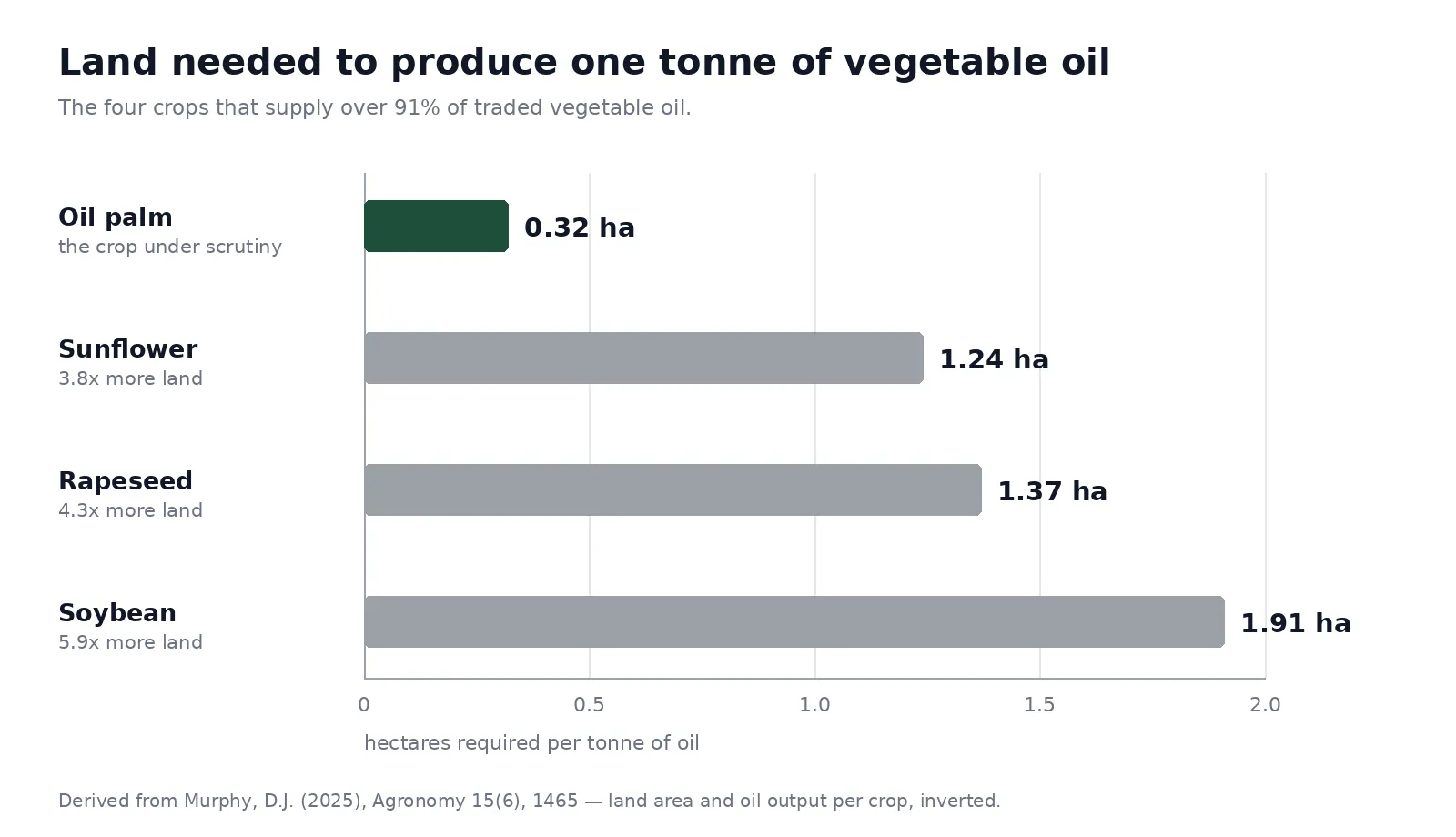
No other oil crop comes close to the oil palm for efficiency. It produces several times more oil per hectare than soybean, rapeseed, or sunflower, which is why replacing it does not shrink the problem. Producing the same tonne of oil from soybean takes close to six times the land, and the International Union for Conservation of Nature puts the gap at up to nine times against the least efficient alternatives. Boycotting palm oil moves the damage somewhere else. It does not prevent it.
So the useful question is not whether to use palm oil. It is how palm oil can be sustainable in practice, and how you would know whether a given shipment actually is. Right now the phrase covers two very different things. It describes a plantation audited against a deforestation-free standard. It also describes a certificate a company bought against oil it cannot locate. The label on the package does not tell you which one you are holding.
Sustainability is proven by traceability depth, not by certification status. The test is simple to ask and hard to fake: can your supplier name the plantation, the mill, and the refinery this shipment passed through?
What follows covers what the standard actually requires, how the oil is grown and processed, where certification genuinely falls short, and four questions you can put to any supplier this week.
What Sustainable Palm Oil Actually Means
What is sustainable palm oil?
Sustainable palm oil is palm oil grown and processed without clearing forest or peatland, without burning, and without exploiting the workers and communities on and around the plantation. That is the definition. Everything else is a mechanism for proving it.
Three certifications cover most of what a US buyer will meet. RSPO, the Roundtable on Sustainable Palm Oil, is the industry standard and audits growers every year against environmental and social criteria. The version in force today is the 2024 RSPO Principles & Criteria, which replaced the 2018 standard. USDA Organic governs what goes into the soil, restricting synthetic fertilizers and pesticides. Regenerative Organic Certified layers soil health, animal welfare, and farmer fairness on top of that organic baseline.
Then there is EUDR, the EU Deforestation Regulation. It requires companies placing palm oil on the European market to supply geolocation coordinates for the exact plot each shipment came from, and to show that plot was not deforested after December 31, 2020. Certification does not satisfy it on its own. The regulation has been delayed and amended since it was adopted. As of September 2026, it applies from December 30, 2026 for large and medium operators, and from June 30, 2027 for most micro and small operators.
That distinction matters more than it looks. A regulator with the power to stop shipments at the border has already decided that a certificate is not the same thing as knowing where the oil came from.
The environmental requirements
The 2024 P&C contains a much broader set of environmental requirements than any short list can cover. Among the core requirements on the ground:
- No deforestation. Primary forest, High Conservation Value land, and High Carbon Stock forest cannot be cleared or converted.
- No peatland development. Planting on peat means draining it first, and drained peat decomposes and releases carbon dioxide. Tropical peatlands store more carbon per hectare than any other terrestrial ecosystem, which is why RSPO prohibited new planting on peat under its 2018 standard, and the prohibition continues under the current 2024 P&C.
- No burning. Fire clearing is banned outright rather than discouraged. Peat fires are close to impossible to put out and can smolder underground for months.
- Habitat kept alongside production. Wildlife corridors, riparian buffers, and protected forest reserve are maintained next to the planted area, not treated as leftover ground.
The social requirements
The environmental rules get the attention. The social rules are where certified and uncertified operations diverge most in daily practice, and where critics say producers quietly fall short.
- Labor conditions. Workers are entitled to safe housing, a decent living wage, and the freedom to organize and bargain collectively.
- No child or forced labor. This is verified by audit, not asserted by policy. Child labor and forced evictions have both been documented across the sector.
- Free, prior, and informed consent. Communities keep legal control of their land and must agree to development on it before anything starts.
- Smallholder inclusion. Growers with plots under 20 hectares supply a large share of world production, and for many of them full certification is close to unreachable. National Geographic reports that Indonesia’s roughly 1.7 million smallholders account for around a third of the country’s output, and that many lack even the legal land paperwork the process requires, let alone the financing.
That last one is the hardest requirement in the standard, and any supplier who tells you otherwise is selling.
Why banning palm oil makes the problem worse
Dropping palm oil feels like the responsible move. It is not.
Every alternative needs more ground for the same tonne of oil. Sunflower takes nearly four times as much land as oil palm, rapeseed a little over four, and soybean close to six. Palm oil covers around 40% of global vegetable oil demand while using under 6% of the land planted to oil crops. That land has to come from somewhere. Demand does not disappear when a brand switches oils. It relocates, usually onto a crop with a worse land footprint and a supply chain nobody is auditing.
So the question worth asking is not which oil. It is which supply chain.
How Sustainable Palm Oil Is Produced, Step by Step
From seed to mill
A palm plantation is a 25-year commitment made in the first year. The seedling a nursery selects sets the yield ceiling for the next quarter century. Planting stock is not a procurement decision. It is a sustainability decision with a very long tail.
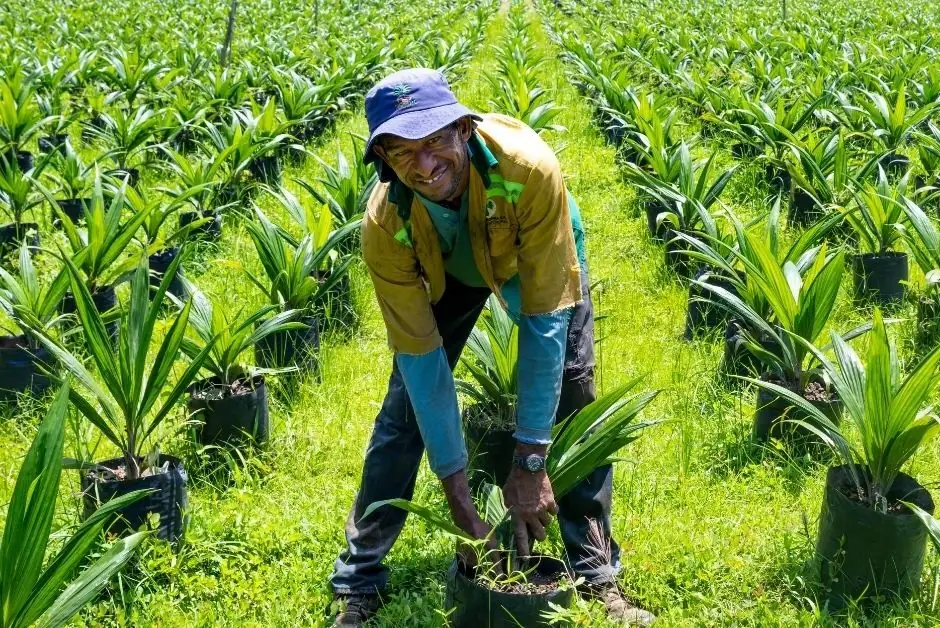
The choice that matters most happens before anything goes in the ground. Planting on already-degraded or previously cultivated land keeps everything downstream defensible. Planting on converted forest does not, and no certificate obtained later repairs it. At one plantation in Gabon documented by National Geographic, more than half the planted area was open savanna, a site chosen deliberately to avoid clearing more forest. That is what the decision looks like when it is made correctly.
A mature planting then runs largely on what it produces. Ground cover crops hold the soil between rows. Empty fruit bunches return from the mill as compost or biomass fuel instead of waste. Mill effluent, a serious freshwater pollutant when it is simply discharged, gets captured and either returned to the land or converted into biogas that powers the mill itself.
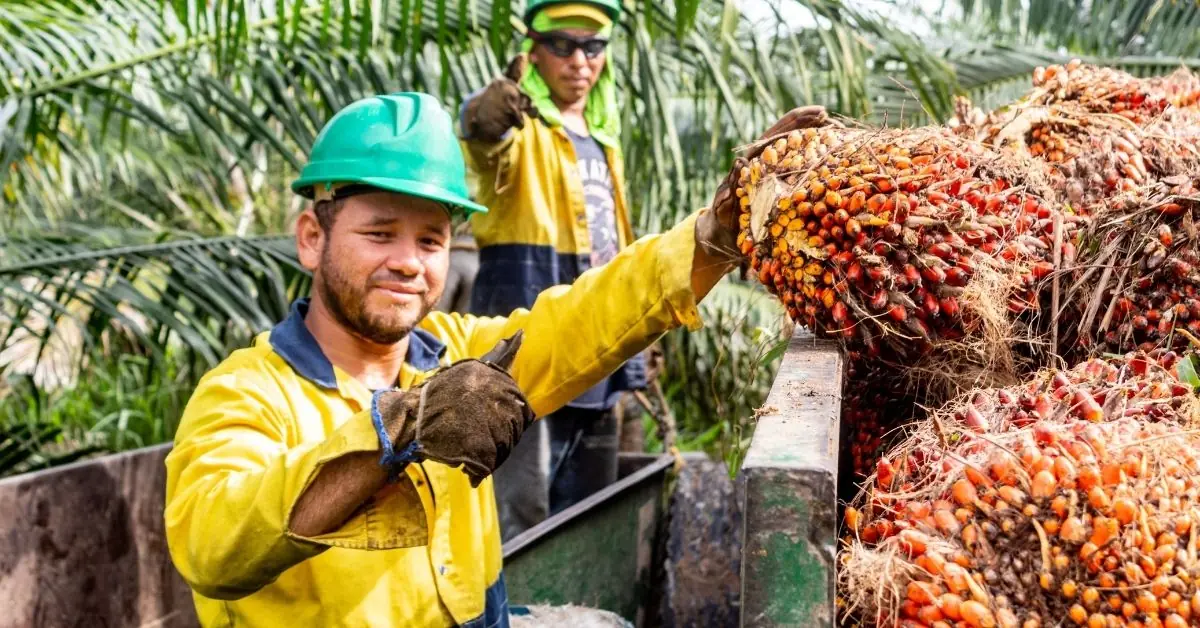
Harvest is where agronomy turns into a clock. Fruit is cut when the first fruitlets loosen from the bunch, and from the moment of bruising, free fatty acids start forming inside it. Deliver the bunches to the mill within 24 to 48 hours and the oil stays under the 5% free fatty acid ceiling international buyers accept. Miss the window and the oil degrades before it is ever pressed. This is why the distance between field and mill is a real physical constraint, not a routing preference.
From mill to refinery
At the mill, fresh fruit bunches are sterilized at roughly 140 to 150°C for an hour or more. The heat deactivates the enzymes driving free fatty acid formation and loosens fruit from the stalk. A threshing drum separates them, a screw press extracts the oil, and what emerges is crude palm oil.
So mill proximity is a sustainability variable, not just a logistics line. A plantation far from a mill either accepts quality loss or sends its fruit to whichever mill is nearest. That second option is where the chain usually breaks.
An independent mill buys fruit from dozens or hundreds of growers and processes it together. Once that fruit enters the sterilizer, nobody can say whose bunches produced which tonne of oil. The mill can be fully certified for its own operations and still have no idea what came through the gate. The certificate is real. The traceability is not.
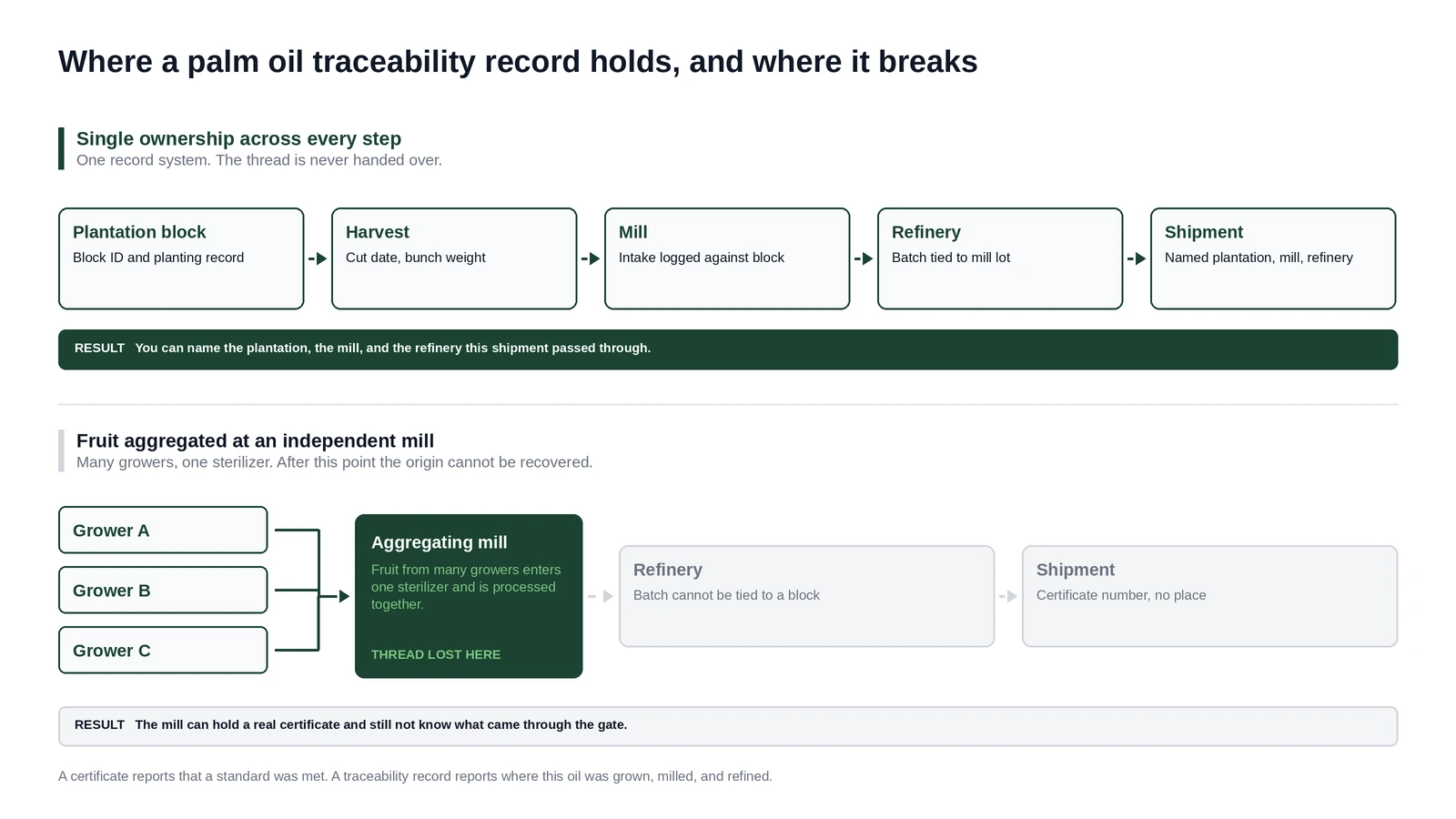
Refining and fractionation add further steps, and every step adds another chance to lose the thread. When a single company owns the plantation, the mill, and the refinery, the audit trail lives inside one record system. When ownership changes hands between steps, each handover becomes a place where paperwork has to be reconciled rather than simply read.
A plot-level traceability record names the plantation block, the harvest date, the mill, the processing date, and the refinery that produced the shipment. Certification requires growers to log their fresh fruit bunch data, and an independent auditor checks those logs against the mill’s own intake records. The question worth holding onto is how much that check actually catches.
Where Certification Stops Short
Is RSPO palm oil really sustainable?
The strongest case against sustainable palm oil comes from people who have watched the certification system closely for two decades. It deserves a straight answer.
The RSPO was founded by the palm oil industry in 2004. Its early criteria restricted clearing of primary forest and High Conservation Value areas, but the comprehensive prohibition covering High Carbon Stock forest and peat did not arrive until November 2018. That is a fourteen-year gap between founding and a full no-deforestation standard. RSPO has since adopted revised Principles & Criteria in 2024, and that version is now in force, so the gap described here is history rather than a description of the current standard. Greenpeace’s assessment, published in 2019, was that enforcement lagged well behind the rule even after it landed.
Certification is also voluntary. It is funded by the companies being certified, and verified by a yearly audit from an independent certification body. A yearly audit is a snapshot. It is not continuous monitoring, and any operation behaves differently on the day the auditor is on site.
The RSPO’s counter-argument is real and worth stating. Its 2026 Impact Report puts the critical land conserved and protected by members at 551,637 hectares, and its complaints system gives plantation workers a formal channel for grievances. Both things can be true at once.
But the sharpest line in the critique is the one worth keeping. Many brands still cannot say where their palm oil comes from. Read that carefully. It is not an argument against palm oil. It is an argument about traceability, and it names precisely the gap this article exists to close.
The four RSPO supply chain models, and why the label alone tells you nothing
Certified oil reaches a buyer through one of four supply chain models defined in the RSPO Supply Chain Certification Standard. They are not interchangeable, and the same RSPO logo can appear on products sourced through any of them.
| Model | How the oil is handled | What you can say about your shipment |
|---|---|---|
| Identity Preserved | Uniquely identifiable to a single certified mill and kept physically isolated from every other source, including other certified oil, at every stage. | You can name the mill it came from. |
| Segregated | Certified oil from multiple certified sources is combined together but kept apart from conventional oil throughout the chain. | You know all of it is certified. You cannot point to one origin. |
| Mass Balance | Certified and conventional oil are mixed during handling. Volumes are reconciled, so certified quantities going in match certified quantities claimed coming out. | The physical oil in your drum is not traced. |
| Book and Claim, sold as RSPO Credits | No certified oil is in the product at all. The buyer funds an equivalent volume produced by a certified grower somewhere else entirely. | Your shipment has no certified content. |
A product carrying an RSPO claim under Mass Balance or Credits is making a real claim and a limited one. It funds certified production. It does not tell you where your oil came from. That is a different statement from Identity Preserved, and nothing on the label makes the difference obvious.
One limitation applies even at the top of the ladder. Identity Preserved traces oil to a certified mill. It does not automatically trace it to a plot of land. That is exactly why EUDR asks for geolocation coordinates on top of certification instead of accepting the certificate as proof.
How to Verify a Sustainable Palm Oil Supplier
Four questions that separate a claim from a chain of custody
A certificate number is easy to email. A chain of custody is not. These four questions surface the difference inside a single supplier call.
- Which supply chain model applies to this specific volume? Not to the company in general. A supplier can hold Identity Preserved certification on one product line and quote you Mass Balance oil from another. Ask about the quote in front of you, in writing.
- Can you name the plantation and the mill this oil came from? A supplier working from mass balance volumes will answer with a certificate number and a scope statement. A supplier with plot-level records will answer with a place.
- Who owns each step between plantation and refinery? Map the handovers. Every change of ownership is a point where one company’s records have to be reconciled against another’s, and reconciliation is slower and weaker than reading a single system.
- What third-party transparency assessment do you submit to, and is it published? SPOTT, run by ZSL, the Zoological Society of London, scores palm oil producers publicly on how much they disclose. A supplier who submits to a published assessment is accepting scrutiny it does not control. A supplier who cites only its own certifications is not.
This last question is the only one whose answer you can check without the supplier’s help.
What the answers tell you
None of this is a pass or fail test. The answers tell you how far back a claim actually reaches, which is a different and more useful thing to know.
Ownership breaks are where traceability weakens. This is rarely about dishonesty. Commingling is structural. Once fruit from many growers enters one sterilizer, no record system can pull it apart afterward. A supplier who owns the plantation, the mill, and the refinery is not more virtuous than one who does not. It simply has fewer places to lose the thread.
Origin concentration is worth raising for the same practical reason. Most of the world’s palm oil comes from two countries. A supply chain anchored in a single growing region carries weather, political, and regulatory exposure in one basket. Buyers who ask about second-origin supply are usually asking a continuity question. The sustainability answer arrives with it.
What This Looks Like in Practice
Those four questions are fair to ask of anyone, including the producer publishing this article. So here are the answers.
DAABON owns the plantations, the extraction plants, and the refineries. There is no ownership break between the field and the finished oil, which is why plot-level traceability here is a record rather than an ambition. Nothing about that arrangement is virtuous in itself. It simply removes the places where the thread usually gets lost.
The oil comes from Magdalena and Santa Marta in Colombia, and from Pará in Brazil, where the Tailândia extraction plants and the Belém refinery joined the group through the acquisition of Agropalma in June 2026. That acquisition made DAABON the largest sustainable palm oil producer in the Americas.
The company has been family owned since 1914 and is run by the third generation of the Dávila Abondano family. That matters more than sentiment in this industry. A palm block planted this year is a commitment to a 25-year cycle, and a family business plants for a horizon it expects to still be standing in.
The certification stack is RSPO, USDA Organic, Non-GMO, Fair Trade Palm Oil, and Regenerative Organic Certified. DAABON was the first palm oil producer in the world to reach ROC Gold level. DAABON has been Top Ranked worldwide in transparency in the palm oil sector on SPOTT, a ZSL Conservation Initiative, across consecutive annual assessments.
Now the honest part. Smallholder verification at scale is still hard. Traceability through mills outside owned operations is still weaker than traceability through owned ones. Both of those are true across the sector, and both are true here. Anyone who tells you those problems are solved is describing a brochure, not a supply chain.
Frequently Asked Questions
What is the difference between palm oil and sustainable palm oil?
Sustainable palm oil is grown without clearing forest or peatland, without burning, and without exploiting workers, and it is audited against those conditions by an independent body. Regular palm oil carries no such requirement and no audit. The two can be chemically identical. The difference is in how the land was used and whether anyone checked.
Can palm oil be ethically sourced?
Yes, but ethical sourcing rests on traceability rather than on a label. A supplier who can name the plantation, the mill, and the refinery behind a specific shipment is making a claim you can verify. A supplier who can produce only a certificate number is making a weaker claim, even when the certificate is genuine.
What causes palm oil to be unsustainable?
Four things, mainly. Clearing forest or draining peatland for new planting. Using fire to clear land. Labor abuses including child and forced labor. And commingling at the mill, where fruit from many growers is processed together, after which no one can say which land produced which oil.
Is sustainable palm oil good or bad?
It is better than the alternatives and weaker than its label implies. Certification has real effects, and RSPO members now conserve more than 550,000 hectares of critical land. It is also voluntary, self-funded, and audited once a year. Treat it as a floor worth building on rather than a finished guarantee.
How do you know if palm oil is really sustainable?
Ask which supply chain model applies to your specific volume, whether the supplier can name the plantation and the mill, where ownership breaks between field and refinery, and what published transparency assessment the supplier submits to. The fourth answer is the only one you can check without the supplier’s help.
How Can Palm Oil Be Sustainable? It Comes Down to One Question
A certificate and a traceability record answer different questions. A certificate reports that a standard was met somewhere in a supply chain. A traceability record reports where the oil in this particular shipment was grown, milled, and refined. Both are legitimate. Neither substitutes for the other.
That distinction is the whole of it. Sustainability is not a category a producer enters by holding the right paperwork. It is a property of a specific volume, and it holds only as far back as the records reach.
So the question to put to a supplier is not whether they are certified. Most credible suppliers are. The question is how far back they can trace the volume they are quoting you, and whether they will put that answer in writing.
Ask Us the Four Questions
Apply them to every supplier on your list, DAABON included. You can review the full product range or start a sourcing conversation whenever the timing suits.
Ask the harder question. The answer tells you what you are actually buying.
Sources
The following sources were used to verify the factual claims in this article.
- IUCN, Palm oil and biodiversity — iucn.org. Source for the finding that other oil crops require up to nine times as much land to produce the same volume of oil.
- WWF UK, 8 things to know about palm oil — wwf.org.uk. Source for palm oil supplying around 40% of global vegetable oil demand on under 6% of oil crop land.
- Murphy, D.J. (2025), Agronomy 15(6), 1465 — mdpi.com. Source for the per-crop land and oil output figures shown in the land use chart. The author chairs the Biology Advisory Committee at the Malaysian Palm Oil Board.
- Roundtable on Sustainable Palm Oil — rspo.org. Reference for the RSPO standard, its 2024 Principles and Criteria now in force, and the Supply Chain Certification Standard defining the four supply chain models.
- RSPO Impact Report 2026 — rspo.org. Source for the 551,637 hectares of critical land conserved and protected by RSPO members, a total covering High Conservation Value areas, High Carbon Stock areas, and peatlands.
- RSPO, Biodiversity impact of RSPO certification — rspo.org. Independent assessment of conservation set-asides within certified operations, including Agropalma.
- European Commission, EU Deforestation Regulation — environment.ec.europa.eu. Reference for the EUDR geolocation and deforestation-free requirements and the amended application dates.
- ZSL SPOTT — spott.org. Reference for the SPOTT transparency assessment, developed by the Zoological Society of London, which scores palm oil producers annually against sector-specific ESG indicators.
- FAO, Palm oil processing — fao.org. Reference for free fatty acid formation after harvest and the field-to-mill processing window.
- National Geographic — nationalgeographic.com. Source for the Indonesian smallholder figures and the Gabon savanna planting example.
- Greenpeace — greenpeace.org. Source for the enforcement criticism attributed to Greenpeace, published in 2019.